A pending label is easy to read as a simple delay, but it usually marks an unfinished process rather than a single event. Search phrases such as fiat withdrawal pending crypto, bank transfer deposit pending crypto, and card chargeback crypto exchange often point to the same underlying question: which part of a payment chain has not reached its next state yet? The answer can sit with a bank, a card-payment arrangement, a clearing operator, an internal ledger, a risk-control process, or more than one of these at once. This article explains the mechanics without treating any status as a prediction of the final outcome.
Pending Is a Status, Not a Single Event
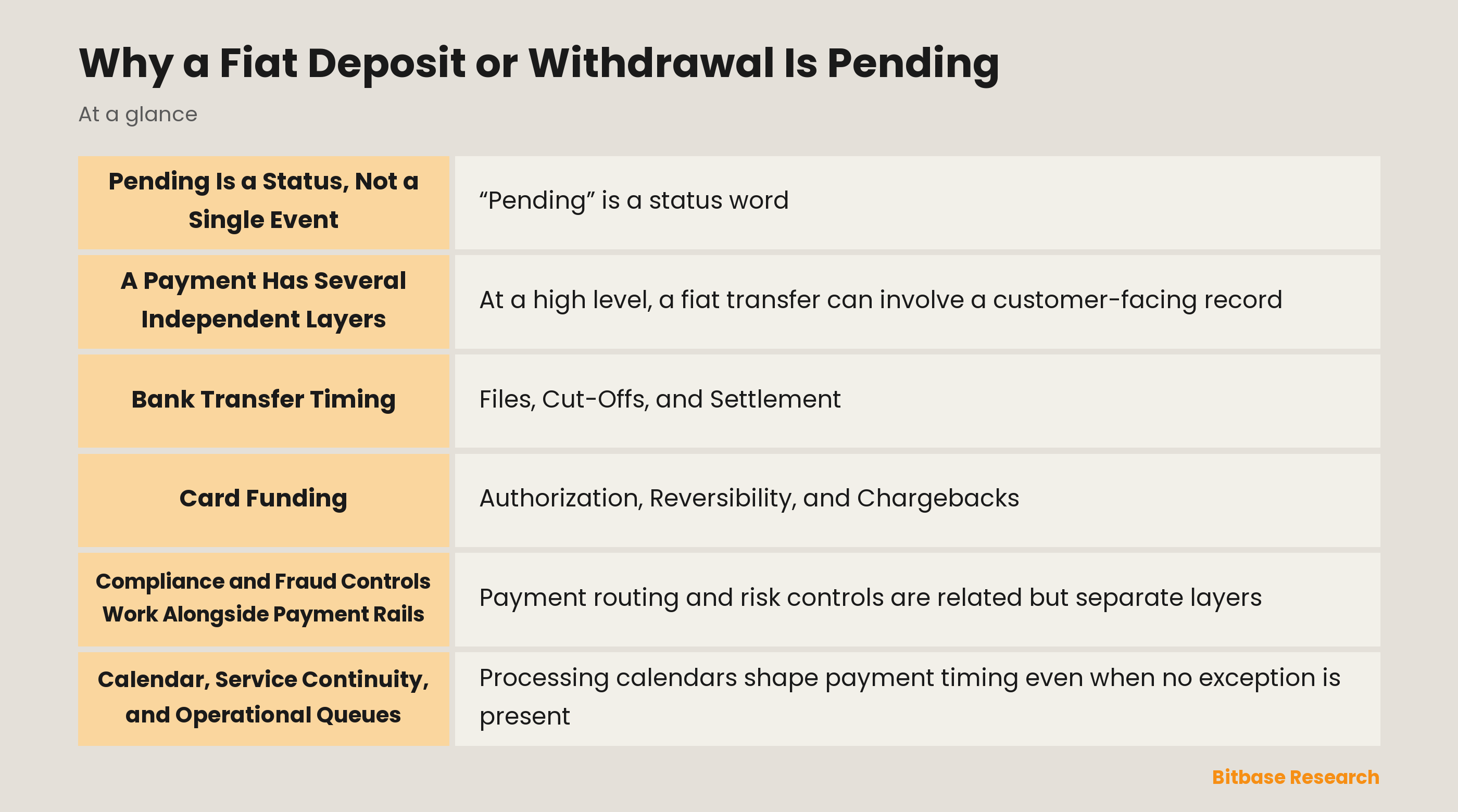
“Pending” is a status word, not a standardized diagnosis. One system may use it after receiving an instruction but before it sends a payment file. Another may use it after a file has been accepted but before the receiving institution posts it. A third may use it while an exception, a timing dependency, or a control review remains open. The same word can therefore describe different work at different points in the chain.
This matters because a fiat movement is rarely one atomic action. It normally has a request, validation, transmission, processing, accounting, and completion or exception stages. A display can be deliberately broader than the underlying event vocabulary: it tells the reader that the movement is not yet treated as final for that system’s purpose. It does not, by itself, identify which participant is working, whether a payment message is moving, or whether money has reached its ultimate destination.
There is also a difference between a message being received and funds being economically available. A receiving system may know that an instruction exists before it has finished its own ledger checks. Conversely, an originating bank may have accepted an order before an interbank operator has processed the batch. Pending can cover either situation. It is therefore best understood as a boundary between an earlier state and a later state, not as an explanation of why the boundary exists.
A Payment Has Several Independent Layers
At a high level, a fiat transfer can involve a customer-facing record, the sending bank or card issuer, a payment scheme or clearing operator, the receiving bank, and the receiving business’s accounting system. Each participant keeps its own records and applies its own timing rules. A status seen in one record need not map one-for-one to the status in another.
The first layer is instruction handling: an institution receives a payment request and determines whether it is structurally usable for its route. The next layer may be network transmission, where messages are gathered, formatted, routed, or held for a processing window. Another layer is interbank settlement, the movement that balances obligations among participating institutions. The last visible layer may be crediting, debiting, or making an entry usable in a particular ledger.
Those layers can move at different speeds. A bank can validate a message while a clearing cycle has not run. A clearing operator can place an item into a batch while the receiving institution has not posted it. A receiving business can see an incoming record while it still distinguishes between a preliminary record and an internally final balance. None of those observations necessarily conflicts with the others; they describe different positions in the same process.
The U.S. Federal Reserve’s description of ACH illustrates this separation. It describes ACH as a nationwide network for batch electronic credit and debit transfers, with operators receiving, sorting, delivering, and settling payments between depository institutions. That model is useful as a mechanism, even though other countries and payment arrangements use different designs. The official description is available from the Federal Reserve Board.
Bank Transfer Timing: Files, Cut-Offs, and Settlement
Bank transfers may be processed individually, in cycles, or through combinations of both. In a batch-oriented arrangement, an instruction can be accepted at one moment but wait for a scheduled file window, a receiving window, or a settlement cycle. A time shown on a transaction record may therefore be the time of acceptance, not the time the transfer became fully processed across all participants.
Settlement is especially important because it refers to the balancing of payment obligations between financial institutions. It is not identical to a consumer-facing message such as “received,” and it is not always identical to a business’s decision about when to update its own ledger. In an ACH example, the Federal Reserve states that operators settle payments by crediting and debiting participating institutions’ settlement accounts. That is a system-level fact; it does not set a universal timeline for any particular transfer.
Cut-off times create another conditional boundary. If an instruction is received after a participant’s operational cut-off, the next eligible processing window may be later. A transfer can also encounter a pause because information must move through separate systems in sequence. The sending side, clearing layer, receiving bank, and receiving ledger may each have their own reconciliation or exception-handling cycles. A pending status can persist while any one of these handoffs remains incomplete.
This is why a bank transfer should not be inferred from a single timestamp alone. The route, currency, destination, message type, participating institutions, and current processing calendar can all matter. Faster rail designs can reduce some waiting, while batch designs can concentrate activity at scheduled times; neither observation determines the state of an individual payment. A pending label remains a description of an unfinished state, not proof of a particular cause.
Card Funding: Authorization, Reversibility, and Chargebacks
Card-based funding has a different shape from a straightforward account-to-account credit transfer. A card transaction can pass through authorization, clearing, presentment, settlement, and post-transaction dispute processes. An authorization can indicate that an issuer has approved a request within its authorization framework, but it is not the same thing as final settlement or a conclusion that every later issue has been resolved.
One reason systems may distinguish a card-funded amount from a final balance is that card payments can be reversible under some circumstances. A dispute may lead to review and, where the relevant rules and facts support it, a reversal or chargeback. The Consumer Financial Protection Bureau notes that a credit card company can in some cases reverse a charge, sometimes called a chargeback, and that a disputed charge can remain subject to an investigation. Its explanation is available from the CFPB.
Reversible does not mean that every card payment will be reversed, nor does it say how any particular dispute will end. It means the payment arrangement includes a possibility of later adjustment under applicable rules. That possibility may matter to how different participants account for a transaction while its payment lifecycle is still open. It also should not be confused with the technical finality characteristics of a separate digital-asset transfer; the funding payment and any later transfer can be distinct events governed by different systems.
Card flows may also involve issuer decisions, scheme messaging, acquirer processing, and merchant-side accounting records. A pending display can reflect an incomplete handoff among those parties or an internal policy distinction between authorization and subsequent stages. The label alone cannot establish whether timing, a network message, a dispute-related condition, or a different factor is responsible.
Compliance and Fraud Controls Work Alongside Payment Rails
Payment routing and risk controls are related but separate layers. A payment message can be technically valid for a rail while a participant still needs to apply compliance or fraud controls appropriate to its role and legal obligations. These controls can consider patterns, counterparty information, transactional context, sanctions-related screening, account security signals, or other risk indicators. Their existence does not establish that any specific transaction is suspicious or improper.
In the United States, the anti-money-laundering rule for money services businesses requires an effective program reasonably designed to prevent use for money laundering and terrorist financing, and says the program must be commensurate with the risks posed by the business. The current regulatory text is 31 CFR § 1022.210. This source supports the general point that compliance frameworks can be risk-based; it does not disclose the decision rules, timing, or outcome for an individual payment.
Fraud controls can similarly operate before, during, or after network processing. They may be automated, may involve queued review, or may be linked to an exception process. A control signal can arise at a different time from a bank’s clearing window, so a payment can be waiting on both operational processing and risk evaluation. Conversely, an apparent delay may be entirely calendar-related or technical and have no compliance component at all.
The important distinction is explanatory discipline. “Pending because of compliance” is not a conclusion that can be drawn from the label alone. Compliance is one possible layer among several. A careful explanation preserves that uncertainty and avoids turning a general regulatory requirement into an assertion about a particular person, account, or transaction.
Calendar, Service Continuity, and Operational Queues
Processing calendars shape payment timing even when no exception is present. Weekends, public holidays, cut-off periods, maintenance work, and recovery procedures can affect when a file is accepted, transmitted, settled, or posted. A service may remain visible to users while one or more underlying functions follow a reduced schedule. The resulting status can still be pending because the next required operating window has not occurred.
The distinction between service availability and end-to-end processing is useful here. A digital interface may accept a request continuously, whereas an underlying bank, clearing service, or destination institution may process particular transfers only during designated windows. Business continuity arrangements can preserve important functions during disruptions, but they can also prioritize reconciliation, integrity checks, or orderly resumption before every queued item reaches its next state.
The Federal Reserve Financial Services holiday schedule provides a concrete U.S. example: its FedACH listing specifies times when processing ends before 2026 holidays and resumes afterward. It also notes that international banking holidays may affect certain cross-border ACH processing. The current schedule is published by Federal Reserve Financial Services. It is evidence of a specific operator’s calendar, not a universal timetable.
Operational queues can also grow around a cut-off, a restart, or a period of unusual volume. Queue order, reconciliation requirements, participant availability, and the handling of exceptions may shape when a given item progresses. A queue is not necessarily a failure, and a resumed service does not imply that every previously received item changes state at the same instant. These are process variables, not fixed promises about duration.
Reading a Pending State Without Overinterpreting It
The most accurate mental model is layered and conditional. A pending fiat deposit or withdrawal can reflect file timing, network routing, interbank settlement, receiving-ledger treatment, the possibility of later card adjustment, a compliance or fraud-control process, a calendar constraint, a continuity event, or a combination of these. It can also reflect a system’s deliberately conservative way of marking an item until its own definition of completion has been met.
That model prevents two common mistakes. The first is assuming that a pending record proves that funds are lost or rejected. The second is assuming that it proves a fixed completion time or final result. Neither assumption follows from the status alone. Different rails have different message structures, participant roles, and legal frameworks; even within one rail, real-world handling can vary by payment type and the current operating conditions.
For educational purposes, it is useful to separate what is observable from what is inferred. Observable facts may include that a status remains pending and that a payment route has known processing or holiday windows. Inferences about the exact reason, the next actor, or the outcome require information that a generic label usually does not provide. This is why a sound explanation names the possible mechanisms, distinguishes the layers, and keeps each one conditional rather than presenting it as a fixed result.
The cited Federal Reserve, eCFR, and CFPB materials are U.S.-focused examples used to explain those mechanisms. They may change over time and do not replace the applicable rules of another jurisdiction, payment arrangement, or institution. Pending is therefore best read as an incomplete state in a multi-party process—informative, but not self-explanatory.
Disclaimer: This article is educational content from Bitbase Academy, provided for information only. It does not constitute investment, trading, tax, or financial advice. Crypto assets are volatile; assess your own risk. Written as of August 2026; refer to the latest official information.
References
[1] Federal Reserve: Automated Clearinghouse Services federalreserve.gov
[2] Federal Reserve Financial Services: Holiday Schedules frbservices.org
[3] eCFR: 31 CFR § 1022.210 Anti-money laundering program requirements ecfr.gov
[4] Consumer Financial Protection Bureau: Credit-card refunds and chargebacks consumerfinance.gov