A zero-knowledge proof is a cryptographic method for establishing that a carefully specified statement is valid without revealing the private information that makes that statement valid. The name can invite an overly broad interpretation. It does not mean that a system reveals nothing at all. A proof normally exposes that a defined statement has satisfied defined verification rules, and an application can still expose public inputs, timing, logs, identifiers, or other metadata outside the proof itself.
The useful question is therefore specific: what statement is being proved, what is private, what is public, and what does successful verification establish? This article introduces those terms before explaining SNARK and STARK as broad families of zero-knowledge proof systems. It is an educational explanation, not a recommendation to use, select, or rely on a particular proof system.
Statements, witnesses, and defined relationships
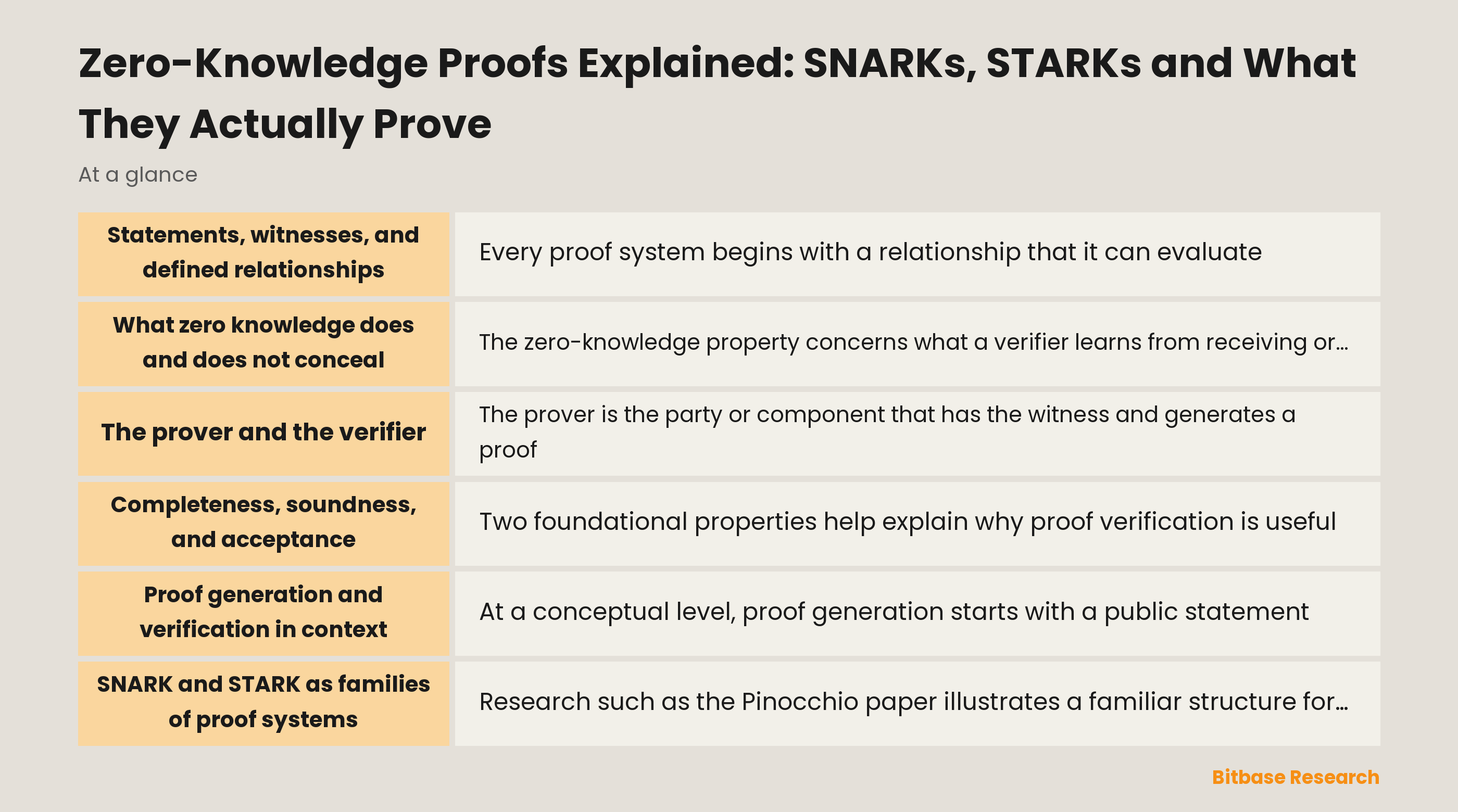
Every proof system begins with a relationship that it can evaluate. The public part is often called a statement. A statement might say that a value satisfies published conditions, or that a computation produced an output according to a declared set of rules. The information that demonstrates why the statement is true is commonly called a witness. A witness can be a secret value, a collection of inputs, or other private information defined by the proof system.
The boundary between statement and witness is important. A verifier can only verify the relationship that was encoded. If a statement says that an input meets a particular condition, acceptance establishes that condition under the system's rules. It does not automatically establish where the input came from, whether every relevant real-world fact was included, or what a person intends to do after verification. Those questions require their own evidence, definitions, and governance.
Many systems describe the relationship through a program-like circuit. Here, a circuit is an abstraction for constrained operations that the proof system can check. It is not simply an ordinary application program. The way a relation is written, the fields it uses, and the constraints it enforces differ across constructions. A proof is consequently about a precise relation, not a vague claim about reality.
This vocabulary also explains why a well-formed statement is essential. If a relation omits an important condition, a proof can still be valid for the incomplete relation. Cryptography can protect the integrity of the defined relationship; it does not decide which real-world requirements should have been placed into it.
What zero knowledge does and does not conceal
The zero-knowledge property concerns what a verifier learns from receiving or interacting with a proof. Informally, the verifier should become convinced that a statement is valid without learning the witness beyond what the statement itself reveals. Classical work on interactive proof systems formalized this intuition by comparing a real verifier view with a simulated view that does not use the witness.
That property belongs to a protocol, not automatically to every layer of a surrounding application. A system may deliberately publish a statement or public input. It may retain logs, expose an identifier, or communicate through a network that carries metadata. A proof may limit disclosure about a witness while other parts of the system create different privacy risks. Privacy analysis must therefore consider the complete information flow, not just the presence of a zero-knowledge proof.
Zero knowledge also does not make a verifier passive. The verifier receives enough proof material to run the prescribed checks. The protocol is designed so that this material supports acceptance of the statement without providing the secret witness in usable form, subject to the construction's assumptions and its stated scope. What is intentionally revealed must remain clear to anyone interpreting a proof result.
The prover and the verifier
The prover is the party or component that has the witness and generates a proof. The verifier receives the public statement, applicable public parameters, and proof data, then runs the system's verification procedure. These are roles rather than fixed kinds of people. An application can arrange them as independent services, local components, or participants in a distributed environment.
Proof generation and verification serve different purposes. The prover demonstrates that it can satisfy the relation using the witness. The verifier checks whether the proof conforms to the relation and its verification rules. The verifier does not have to reproduce the private calculation merely because it has received a proof. The exact amount of work, proof material, interaction, and public setup differs by construction.
Context matters as well. A proof valid for one statement is not automatically meaningful for another statement. Versions, public inputs, relation definitions, and verification material can all affect interpretation. A proof system cannot determine whether a technical result is appropriate for a legal, scientific, organizational, or social decision. Defining the relation and deciding how to interpret it remain application responsibilities.
Completeness, soundness, and acceptance
Two foundational properties help explain why proof verification is useful. Completeness says, roughly, that an honest prover with a valid witness for a true statement should be able to produce a proof that an honest verifier accepts. Without completeness, a correct participant could be rejected even though the relation had been satisfied.
Soundness addresses the opposite direction. Roughly, it says that a prover should not be able to make a verifier accept a false statement except with the limited probability or under the assumptions specified by the system. Soundness is not a universal fact-checking property. It applies to a formal relation, an adversary model, and a security definition. It does not independently prove that inputs were collected correctly or that an unencoded real-world assertion is true.
Some constructions also discuss knowledge soundness. At a high level, the term connects a successful proof to the idea that the prover possesses, or can produce, a witness of the required kind. Its precise definition is technical and construction-specific. It should not be restated as a claim that the prover knows every contextual fact a reader might associate with the public statement.
Together, completeness and soundness make acceptance meaningful in a bounded way: correctly formed evidence for a true relation should be accepted, while false relations should not be accepted merely because they are asserted. They do not eliminate the need to state the right relation, implement it correctly, and evaluate the result in context.
Proof generation and verification in context
At a conceptual level, proof generation starts with a public statement, a private witness, and a relation linking them. The prover performs the operations prescribed by its proof system and produces proof data. Verification starts with the public statement, the required verification material, and that proof data. The verifier then returns acceptance or rejection according to the protocol.
Different systems make different choices about interaction, randomness, public parameters, cryptographic assumptions, and the way computations are represented. Some include a setup phase that creates parameters; others use designs described as transparent because they avoid a secret setup participant. These design choices are important, but labels alone do not establish that a complete implementation has the intended security properties.
For readers, four questions remain useful across systems. What exact statement is public? What is the witness? Which verification material is assumed or trusted? What does acceptance establish, and what does it leave unaddressed? Those questions are relevant whether a proof is connected to a ledger, a credential, a database, or another software system.
SNARK and STARK as families of proof systems
SNARK is commonly expanded as “Succinct Non-interactive Argument of Knowledge.” In broad terms, SNARK constructions seek to let a prover produce a compact proof that a verifier can check without an interactive exchange. “Argument” has a technical meaning: the security rests on computational assumptions rather than an unconditional mathematical guarantee. Individual constructions can differ in setup model, assumptions, proof representation, and the relations they support.
Research such as the Pinocchio paper illustrates a familiar structure for verifiable computation: public material describes a computation, a worker produces a proof for a particular input, and a verifier checks that proof. That historical example should not be treated as a definition for every later system described as a SNARK. The umbrella term covers related ideas, not a single uniform implementation.
STARK is commonly expanded as “Scalable Transparent Argument of Knowledge.” The term is associated with constructions that emphasize transparency in their setup model and use proof techniques different from common pairing-based SNARK approaches. The original STARK research discusses transparent computational integrity and a post-quantum security context. Those descriptions concern a construction and its assumptions; they do not make every implementation interchangeable or establish a universal result.
The most useful comparison is therefore specific. It considers a particular construction's formal assumptions, setup requirements, representation of the relation, verification environment, implementation quality, and public data. SNARK and STARK are concept maps, not automatic conclusions about a system's security, privacy, or suitability.
Scope, limitations, and surrounding trust
A valid proof establishes only the statement represented by its relation. It does not independently show that underlying data was collected fairly, that a source was authorized, that an off-system event occurred, or that the statement remains current. If a relation receives incomplete or misleading inputs, verification may still be correct with respect to those inputs. The proof protects a defined computation, not every possible interpretation of its result.
Zero knowledge also does not remove all privacy considerations. Public inputs can be revealing. Repeated presentations can create associations. Network, device, account, interface, and application metadata can exist outside the proof. A design must examine these channels directly rather than treating the proof as a complete privacy boundary.
Practical security additionally depends on mathematical assumptions, parameter handling where applicable, correct software, and a verifier that evaluates the intended statement. Failures at any of these layers can change the outcome. This is why short labels such as SNARK or STARK should be a starting point for careful reading rather than a final judgment.
When interpreting a proof claim, identify the statement, witness, public inputs, prover, verifier, and verification material. Then separate technical acceptance from broader trust: a verifier may establish that a result meets protocol rules while still needing to assess sources, definitions, context, and its own policies. That disciplined distinction captures what zero-knowledge proofs actually prove and where their boundaries remain.
Disclaimer: This article is educational content from Bitbase Academy, provided for information only. It does not constitute investment, trading, tax, or financial advice. Crypto assets are volatile; assess your own risk. Written as of August 2026; refer to the latest official information.
References
[1] Goldwasser, Micali and Rackoff: The Knowledge Complexity of Interactive Proof Systems people.csail.mit.edu
[2] IACR ePrint 2013/279: Pinocchio eprint.iacr.org
[3] IACR ePrint 2018/046: Scalable, transparent, and post-quantum secure computational integrity eprint.iacr.org
[4] W3C: Verifiable Credentials Data Model v2.0 w3.org